James Bogash, DC
Healthy Kids
Are Your Cooking Pans Damaging Your Child’s Health?
You know those wonderful, non-stick pans that you love so well? I hope you realize that many of today’s “conveniences” like non-stick cookware come with a price beyond the initial purchase.
The wonderful Teflon that keeps all your foods from sticking to the pan is no exception. The chemical compounds typically found in non-stick cookware include 25 cent words like perfluorooctanoic acid (PFOA) and perfluorooctanesulfonate (PFOS). Toxic compounds like these have been found to affect thyroid function, cancer risk and heart disease.
In this particular study, researchers looked at the relationship between PFOA and PFOS levels and cholesterol levels in 12,476 children. Here’s what they found:
- PFOA was linked to higher total cholesterol and LDL-C
- PFOS was linked to higher total cholesterol, HDL-C, and LDL-C
Even if these compounds were not linked to heart-disease-friendly changes in blood lipids, do we really want something called “perfluorooctanoic acid” in our children’s blood anyway when the word is too long to even fit on a Scrabble board??
Toss your non-stick cookware and buy stainless steel.
“Smoking Gun” of Childhood Leukemia and Lymphoma Found

When a 50 year old 3-pack-a-day smoker gets lung cancer, we all shake our head. But when it’s a 6 year old, only horror is felt.
Personally, I have always believed that childhood cancers come from a bad combination of genetic susceptibility and environmental chemical exposure. Either way, it is in no way, shape or form from decisions that the child has made. Unless, of course, the child independently decided to take up smoking at 3 and moved next to a nuclear waste dump against parental advice.
Personally, I have done everything possible to reduce or eliminate my family’s exposure to toxic chemicals. Selective vaccinations (yes—this little tidbit is glided over when describing the risks of vaccination…), no non-stick cookware, glass or stainless steel containers and glasses, no herbicides, no pesticides, organic foods when possible and only essential-oil based fragrances.
I remember a time when we had an ant infestation. There was a clear trail from outside directly to one of the dog bowls, where they had immersed themselves in the leftover dog food. Outside and along the inside of the molding I sprinkled grits. But since grits take some time to work, I remember crawling around on the floor with duct tape capturing all of the home invaders. My then-toddler thought it was a blast.
This is not the extent to which most people would go through to protect their family from toxins, but I’ve always had a distinct fear of toxic chemicals, regardless of how “safe” they have been declared. (BTW—the “safety” of most of the pesticides in use today have been determined by the companies that manufacture them)
Time and time again, my fears, when it comes to how much of an impact that toxic, everyday, household chemicals have on our healthy, have proven well-founded. This time is no different.
In this particular study, researchers looked across 13 different studies to evaluate the impact that pesticides used in the home have on the risk of childhood leukemia and lymphoma.
Of all the cancers, the blood-origin cancers, leukemia and lymphoma, are among the scariest. The solid tumors like breast, prostate, colon and pancreatic, have very well-defined lifestyle risk factors like diet and exercise. Not so with leukemia and lymphoma. Sure, your dietary choices play a role, but this role is not as great as the hidden chemical exposures that increase risk.
“Hidden” being the scariest word in that paragraph. Personally, I’m pretty well aware of where these hidden chemicals lie, but the average person is unaware of most. And the ones that we should be aware of and avoid are so commonly used that no one questions them.
Household pesticides are one of these chemicals, as we really see in the results of this study:
- Overall, indoor residential insecticide exposure was linked to a 47% higher risk of childhood leukemia and a 43% higher risk of lymphoma.
- Even worse, when both indoor insecticide exposure and professional home treatment exposure was present, this risk jumped 204% higher.
- The overall risk for all childhood cancer from indoor pesticide exposure in general was increased 40%.
These are some scary numbers, especially with the combination of professional and non-professional home use. I know that many of the pesticide companies will only spray outside the house, but I would still be worried. We really have no idea how much of these chemicals make it into the home.
And here’s the rub—at least here in the Phoenix area, there are a large number of pest prevention companies. It’s a thriving business. And this means that there are a large number of people in developed countries that are exposing themselves and their families to toxic chemicals that are known to increase the risk of childhood cancers.
Maybe the next time you see a cockroach running across the floor it’s not the time to run to the phone and call the exterminators.
How Can We Increase the Likelihood of Breastfeeding?
Are You Paying Attention to What Your Kids Are Eating at School?
We’re always so quick to blame school lunches as being of very poor nutritional quality (they are), but few are very good at looking at what they are choosing to pack in their children’s sack lunches.
Convenience items like cheese and crackers, processed lunchmeat and packaged cheeses are typical. This particular article finds that few of the sack lunches brought from home meet the low standards provided by the government.
We also need to understand that this starts in daycare, with federally funded programs like WIC providing very low quality, low phytonutrient foods. Goldfish? Sugared applesauce? HFCS yogurt?
Can anyone tell me how these foods fell into the “healthy foods” category? We need to wake up and realize that we are beginning to destroy our children’s health at a very young age.
Consider this…if we assume 3 meals / day 7 days / wk that is 21 meals / wk. If kids are eating breakfast and lunch fed to them by a school system, we are talking about 10 / 21 meals per week of questionable value. That is, of course, assuming that home meals are healthy.
Is YOUR Stress Programming Your Kids for Depression?
Do You Know What YOUR Child is Wearing? 5 Tips to Keep Them Safe

Chemicals are everywhere in our world. I’ve said before that we live in a toxic soup, and that absolutely includes our children.
Our kids have a particular susceptibility to toxins in our environment because their detoxification ability is not as strong as an adult’s. To make this worse, we are particularly sensitive to the plight of children and the scary fear that their pajamas may burst into flames at any given moment.
Yes. Spontaneous combustion. The eternal fear of lawmaking officials.
The problem is that it requires chemicals to meet the standards that are required. There are natural materials that a naturally flame-resistant, but industry doesn’t seem interested in using these fibers.
Still all of this would be OK if we are saving lives without the cost of toxic exposure to our children while trying to prevent the almost 200 burns due to clothing in the US per year. The current standards require the materials to resist an actual flame for a certain period of time. Clothing that fits close to the skin is far less likely to catch on fire and does not require the higher flame resistant standards.
California sets the standard for the rest of the country when it comes to flame resistance in household materials and the rest of the country just seems to follow suit. Which would be just fine if any of the chemicals used in the process of making children’s clothes flame retardant underwent any type of safety testing.
In other words, the use of chemicals to meet flame resistant standards is mandated, but any safety testing for these same chemicals is not required. Quite a catch-22.
(The following information is from a viewpoint article written by Dr. Eric Hecht, Dr. David Landy and Julien Thomas)
As a way of history to show just how backwards this is, the Consumer Product Safety Commission (CPSC-the government entity that oversees this type of thing), in 1977 banned the use of CFR 2,3-dibromyopropyl phosphate one year after it was introduced. Unfortunately, it turns out that this compound was absorbed through the skin and had the potential to cause DNA mutations.
After this, the polybrominated diphenyl esters (PBDE) took over and became the most widely used flame retardant. That was until 2004 when concerns again arose over the toxicity of certain PBDE and these were likewise removed from the market. These concerns ranged from endocrine disruptions, neurodevelopmental disorders and cancer.
Just in case you thought this was the end the debacle, another PBDE called decabromodiphenyl ester was banned in several states in 2013 over the same concerns.
Overall, some billion pounds of flame retardants are used annually in the US, where the typical household contains several pounds in clothing, furniture, electronics and insulation. As these materials break down, they attach to dust particles and can make it into ours and our children’s bodies by this route as well. This results in children in the US having toxic levels of flame retardants that are some 10 TIMES higher than other countries.
And our pets? That’s even worse since they are much closer to the sources of these chemicals.
All of this wouldn’t be an issue if these toxic chemicals were not linked in children to neurodevelopmental disorders, lower IQs, ADD and other behavioral problems.
The regulation of these compounds is slim, and a huge chunk were grandfathered in when the Toxic Substances Control Act was passed in 1976. Overall, this is a scenario where you need to be proactive in protecting your children from toxic exposures rather than trusting in the manufacturers and the government to ensure that products used are safe for your family.
Here are some tips:
- For pajamas, use form fitting clothing that do not require the flame resistant standards of loose pajamas.
- Look for clothing and toys made with naturally-flame resistant materials (this article is a great resource).
- Consider the mattresses your family sleeps on. Standards were changed in 2007 to include more toxic chemicals, but in my recent search for a new mattress, many of the larger manufacturers have move to naturally flame-resistant fibers to meet the standards.
- Throw out items that have been in use for too long. Drapes, carpets, rugs, dog beds, furniture–as these age, the toxic chemicals in them leach out into your house.
- Purchase air filters for your home and dust, sweep and vacuum frequently to keep dust to a minimum.
For a long time, I considered the foundation to health to consist of diet, exercise and stress management. Unfortunately, over the years which growing use of chemicals everywhere in our environment, I’ve had to add an environmental tab to this foundation. The problem with this aspect is that is remains largely unknown to most of us, yet has a direct effect on health.
Everyone knows that the McDonald’s Big Mac they are going to eat is bad for them, but few consider the hidden danger of returning to a car after that fast food meal that has been baking in the sun for a 1/2 hour and breathing in the toxic phthalates that have been off-gassing in the heat.
Scary.
Are You Giving Your Kids this Vitamin?

You take your vitamins religiously. You exercise and watch what you eat. But your kids? You send them to school with a Twinkie and fruit juice and don’t think twice about vitamins for them.
It’s not that you don’t care about your kids, it’s just that we don’t really think of them as having the problem. We think of kids being more resilient and the choices that they make not having a long term impact. But we just now that this isn’t true. There is a long list of things that happen to children that have effects decades later as an adult. These can include:
- Childhood maltreatment (physical, emotional, nutritional, sexual)
- Exposure to parents who smoke
- Antibiotic exposure as an infant
The point is that things that happen in childhood DO matter. These things can play a huge role in the health challenges your child will or will not have to deal with as an adult.
That’s a pretty strong responsibility as a parent.
Luckily some things are easier to implement. Which brings us to this particular study looking at the relationship to vitamin D levels in children and the health of their blood vessels 27 years later (as measured by carotid artery intima media thickness, or IMT). Here’s what they found:
- Children with the lowest levels of 25-OH vitamin D (<40 nmol/L or 16 ng/ml–a very low number) were 70% more likely to have high-risk IMT.
- These same low-level vitamin D kids were 80% more likely to have risk factors for heart disease as an adult.
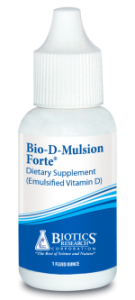
This is a very simple addition to your child’s routine. With Keegan (9 years old), he gets 6,000 IU of vitamin D per week. That’s only 3 drops per week of the Biotics Bio-D-mulsion Forte formula that I recommend here in the office. I will usually add another drop of Biotics Bio-Ae-mulsion Forte as well (vitamin A 12,500 IU) to help support immune function.
This combination has seemed to keep his immune system humming at top efficiency and according to this study, may be protecting his blood vessels at this very moment…