BREAKING THE CYCLE OF CHRONIC DISEASE BEGINS HOW EARLY? Based on previous posts, this shouldn’t be a trick question. The answer is before pregnancy. In this study, women who gained excess weight during pregnancy had children that, at 9 years of age, had pretty much EVERY risk factor for heart disease elevated. A literal time bomb that will explode decades before it exploded for the parents. I’ve said it before and I’ll say it again, we need to stand up for the health of our children by taking better care of ourselves during pregnancy. This goes for BOTH the dad and the mom. The decisions you make today are either helping your child grow up healthier, or you are loading a bullet in the chamber. Decide. You can’t sit on the fence.
Diet Choices for Your Best Health
Adding This Simple Snack Can Extend Your Life
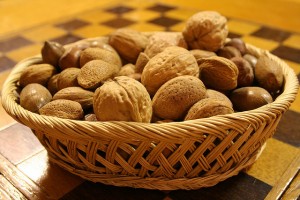
Sure–you know that avoiding smoking, exercising regularly and eating lots of veggies and fruits will help you live longer. But can one simple snack extend your life?
Turns out that if the snack consists of different types of nuts the answer is probably a solid yes. The benefits of nuts on our long-term health is well-documented. They protect your brain, they protect against diabetes and they strongly protect your heart. And the benefits are not isolated to a single type of nut–it seems like every time researchers look at a particular type of nut it shows a protective effect on whatever chronic disease that happens to be in the study.
However, there are a few very important factoids to take into account.
First, raw nuts are the best option. Absolutely, positively NO added oils. That means cottonseed oil, peanut oil and any other oil manufacturers try to stuff into the nut container. These added oils will completely counteract the benefits of the nuts. Personally, I buy bulk bags of almonds, pecans and walnuts from Costco because their prices on these 3 types of nuts is the lowest you can find. Then, when Sprouts has other types of nuts on sale, like cashews or hazelnuts, I add them to the mix. If I’m feeling really rich, I’ll splurge on a pound of macadamia nuts.
Next, I really don’t concern myself over added salt. The research linking low salt diets and chronic disease is very weak and likely is more due to the presence of high levels of sodium (and low potassium) in processed foods. Personally, however, I prefer to match my nuts with dark chocolate drops instead of salt to spruce up the experience.
Either way, the addition of nuts to your daily routine is a powerful one. But just how powerful? This particular study asked this very question. It looked at 17,184 residents of Spain over the course of 5 years to see if nut consumption had any effect on the participants risk of dying from any cause (all-cause mortality). Here’s what they found:
- Those participants who ate nuts at least twice per week had a 56% lower risk of dying when compared to non-nut consumers.
These are some pretty serious numbers.
This powerful effect of nuts is likely due to several factors present within nuts. First, they help you avoid snacking on other, less healthy, snacks. The fat present in nuts (polyunsaturated and monunsaturated) has consistently shown to protect your heart from damage. Lastly, they are an excellent source of gamma tocopherol–the powerhouse form of vitamin E that has been shown again and again to protect the brain and the heart.
Either way, if you are not already snacking on nuts during a typical week, it’s definitely time to start.
Soy Foods on the Hotspot Again: Ovarian Cancer
Run a Google search for “soy” and the first page or two are dominated by “soy kills” websites. The general public seems to think that soy is not good for you.
Many of these sites have one thing in common; by the time you get past all the hype, everyone seems to agree that, so long as you avoid processed and GMO, soy may actually be good for you. This means anything that contains TVP (textured vegetable protein), most veggie burgers and any soy product that is not labeled as organic or GMO free.
In addition, since soy is so darn prevalent in our processed foods and infant formulas, soy allergy is not uncommon. There also does seem to be some relationship between soy and thyroid function, but there is very little actual research to back this concern up.
In all the research that I have read over the years, it is almost unheard of to find negative effects of soy. The vast majority of the studies show distinct and powerful effects on human health. This particular study, looking at the effect of different soy-based foods on the risk of ovarian cancer. And the results are pretty stunning:
- In this China-based study of 500 ovarian cancer patients, Information on habitual consumption of soy foods, including soybean, soy milk, fresh tofu, dried tofu, and soybean sprout, was obtained.
- There was a lower average consumption of soy in ovarian cancer patients compared to matched controls (75.3 grams/day versus 110.7 grams/day.
- It was determined that that regular intake of soy foods could slash ovarian cancer risk by 71% in women who consumed at least 120 grams/day when compared to those who consume less than 61 grams/day.
To put this in perspective, a ½ cup of edamame is 90 grams and 1/3 cup of tofu is about 85 grams, so we’re not talking about mass amounts of soy. Basically, less than 2 servings per day.
Seventy one percent lower risk of ovarian cancer. Add in a diet low in red meat, skip dairy and avoid hormone replacement therapy and you’ve pretty much eliminated all risk of ovarian cancer.
Just don’t wait for soy to make it to the front page of the newspaper as being good for you.
Dietary Deficiencies Linked to Elevated BP in Adolescents of Color – (11-06-00)
Dietary Deficiencies Linked to Elevated BP in Adolescents of Color
With volumes of research pointing to the importance of our growth years and adult chronic diseases, does anyone really believe that our lifespans are going to increase? If we want to have the most important aspects on our country’s health as a whole, we HAVE to focus on the children.
Arch Pediatr Adolesc Med 2000;154:918-922 Adding to the mounting evidence of the effect of diet on hypertension, a new report suggests that among urban minority adolescents, diets deficient in a range of nutrients may contribute to elevated screening blood pressure levels. Dr. Bonita Falkner and colleagues from Thomas Jefferson University, in Philadelphia, collected data on 108 boys and 72 girls between 14 and 16 years of age, 79% African American and 21% Hispanic. All subjects had blood pressure higher than the 90th percentile. Dr. Falkner’s group obtained folic acid measurements as an index of fruit, vegetable and whole grain intake, and they obtained a 24-hour food intake recall. “Mean diastolic blood pressure was significantly higher in the low-folate group versus the high-folate group (boys: 72 versus 67 mm Hg; girls: 76 versus 73 mm Hg),” the researchers write. Dr. Falkner’s group reports that the intake of potassium, calcium, magnesium, beta-carotene, ch! olecalciferol, vitamin E and all B vitamins was significantly lower in the low-folate group compared with the high-folate group. The investigators note that their findings are consistent with the “dietary benefits on blood pressure level observed in the Dietary Approaches to Stop Hypertension (DASH) trial.” Diet, they believe, may be an approach to “primary prevention of hypertension when instituted at an early age.”
Bacterium Linked to Crohn’s Disease to Be Removed From Milk in UK – (11-02-00)
Bacterium Linked to Crohn’s Disease to Be Removed From Milk in UK
My gosh…how much more evidence do we need???? Cow’s milk is NOT good for us. Loaded with hormones and antibiotics, a very common allergen, may actually contribute to fractures instead of protect, linked to Type I diabetes in children, and now this? When are we going to wake up??
(article) British health experts are to look at ways to eliminate a bacterium in milk that has been linked to Crohn’s disease from entering the human food chain, the Food Standards Agency (FSA) said o Monday. As reported by Reuters Health, some scientists have warned that Mycobacterium paratuberculosis is widespread in the environment, survives pasteurisation, and is likely to be implicated in causing the bowel disorder. In a news release last week, the FSA confirmed that the bacterium can survive normal and even prolonged pasteurisation. Preliminary survey results had found it to be present in 1.9% of raw milk samples and 2.1% of pasteurised milk samples in the UK. The agency said independent experts on the Advisory Committee on the Microbiological Safety of Food had now examined the evidence that M. paratuberculosis might trigger Crohn’s disease. Although there was no proof, they were concerned that there might be a link.
Diet, Body Size Influence Age of Menarche, Adolescent Growth – (10-16-00)
Diet, Body Size Influence Age of Menarche, Adolescent Growth
More evidence continues to accumulate relating lifestyle and diet as children to diseases later in life. Considering the poor state of our children’s diet and increase in processed and fast food, can we still continue to delude ourselves into believing that our lifespans will actually increase over the next few decades?
Am J Epidemiol 2000;152:446-52 Diet and body size in early childhood influence the age at which girls achieve menarche as well as their growth during adolescence. “Menarche occurred earlier in girls who were taller and who consumed more (age- and calorie-adjusted) animal protein and less vegetable protein as early as ages 3 to 5 years,” the investigators report. The girls experienced their peak height growth at a mean age of 11.12 years, and the mean peak growth velocity was 7.99 cm/year, Dr. Berkey’s team determined. Peak velocity was noted at a younger age among girls who consumed higher levels of fat than average between ages 1 and 2 years, ate more animal protein than average between ages 6 and 8 years, or were taller than average before they were 6 years of age. The risk of some adult diseases is thought to be influenced by adolescent growth and development factors, the researchers note, “and this paper suggests that several adolescent factors might be modifiable by dietary changes in young children.”
Decreased Carotenoid Concentrations Due to Dietary Sucrose Polyesters – (03-10-03)
Decreased Carotenoid Concentrations Due to Dietary Sucrose Polyesters Do Not Affect Possible Markers of Disease Risk in Humans.
Okay, here’s the story…dietary sucrose polyesters (read “Olestra”) lower serum carotenoid concentrations, but hey–a couple of the markers of disease risk weren’t affected. So basically, to pass Olestra onto the general population the manufacturers can’t dispute the fact that Olestra lowers absorption of many fat soluble vitamins, so they’re basically saying that it’s no big deal. Care to bet on your own health on that one?
nutrition.org — Abstracts: Broekmans et al. 133 (3): 720
Cardiac Benefits of Fish Consumption May Depend on the Type of Fish Meal Consumed – (03-18-03)
Cardiac Benefits of Fish Consumption May Depend on the Type of Fish Meal Consumed.
Wow!! Here’s another incredible research finding. Fish 3x or more per week lowered risk 49% of total IHD death and 58% lower risk of arrhythmic IHD. Fried and breaded fish sandwiches, on the other hand, seemed to increase risk slightly. My gosh…who agrees to pay for these studies!!??
Circulation — Abstracts: Mozaffarian et al. 107 (10): 1372