• Skip to main content
  • Skip to primary sidebar
  • Skip to footer

LifeCare Chiropractic

The Best Chiropractic Care in Mesa, Arizona

  • Home
  • About
    • Why Lifecare?
    • About Dr. Bogash
    • Team Members
  • Common Conditions
    • Wrist Pain/Carpal tunnel syndrome
    • Elbow Pain/Epicondylitis
    • Headaches
    • Knee Pain and Knee Injuries
    • Low Back Pain
    • Shoulder Pain and Rotator Cuff Problems
  • Additional Services
  • Testimonials
  • Blog
  • E-Books
  • Contact

Gastric Cancer

Do Gastroesophageal Reflux Disease Drugs Lead to Cancer?

May 21, 2014 by James Bogash

gastroesophageal reflux disease and cancer
Amazon links

For those who have educated themselves, the big fear of uncontrolled gastrointestinal reflux disease is that it could turn into esophageal cancer.

Because of this fear, people accept the idea that using drugs that block stomach acid is the right thing to do.  After all, acid splashes up on the esophagus and damages the lining because it is not designed for that type of abuse.  The damaged lining of the esophagus tries to heal and, over time, these cells break down from the chronic damage and become precancerous.  This condition is referred to as Barrett’s esophagus and it is a strong risk factor for later development of esophageal cancer.

For many years now, mainstream medicine has approached this problem using drugs like Nexium and Prilosec with a tenacity of the papparazzi on Britney Spears.  But blocking stomach acid, an absolutely critical component of digestion, wreaks havoc on your body’s ability to live healthy.  Few drugs will create as many long-term problems as drugs to block stomach acid.  With the exception of maybe antibiotics, which can take years to recover from, if ever.

I have certainly covered the dangers of blocking stomach acid in previous articles that can be read by clicking here, so I won’t go over them again.  But let’s just sum it up by saying that it’s a baaaad idea.  Of course, if you have a perforated ulcer and you are bleeding internally, than this class of drugs will be a lifesaver.  But for the rest of you not lying in a hospital bed pasty white from anemia this is not a good idea.

So what does all this have to do with this particular article?  In it, researchers took an interesting look at the bacteria in the upper gastrointestinal tract and the risk of developing esophageal or stomach cancer.  More specifically, they looked at how much diversity there was in the bacteria found.  Keep in mind that higher diversity is usually a good thing and a sign of a healthier bacterial flora.  (Antibiotics decimate bacteria flora diversity, just so you know…)  The bacterial diversity was then compared to known markers that increase the risk of development of esophageal and gastric cancer (serum pepsinogen I/pepsinogen II ratio or PGI/II for gastric cancer risk and esophageal squamous dysplasia or ESD for esophageal squamous cell carcinoma).  Here’s what they found:

  • Lower microbial diversity (number of bacterial genera per sample) was led to higher risks for both gastric and esophageal cancer.

Before you can realize just how important this is, you need to know that the use of drugs that block the production of stomach acid interfere with the normal balance of bacteria in the gut.  When you block stomach acid, you’ve just destroyed your body’s ability to kill off certain bacteria that are NOT supposed to grow in the GI tract.  This leads to a condition known as small bowel bacterial overgrowth–bacteria growing where it is not supposed to be growing.

In general, any drug that is going to interfere with the normal function of the GI tract is going to upset the delicate balance of bacteria residing there.  This means that antibiotics and drugs that block acid production may very well contribute to the development of the very cancers that doctors are mistakenly using these classes of drugs to try to prevent.  Talk about a backwards system.

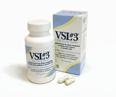
This also means that using heavy hitting probiotics (like VSL-3 high potency probiotics that I am a very big fan of for those patients who have really screwed up their systems with antibiotics) should be an important part of your cancer-prevention routine.

Filed Under: Digestive Complaints, Gastroenterology, Probiotic Tagged With: Esophageal Cancer, Gastric Cancer, Gastroesophageal reflux disease, GERD, probiotics, reflux

Animal Products and Risk of Esophageal and Gastric Cancer – (11-05-01)

August 17, 2013 by James Bogash

Animal Products and Risk of Esophageal and Gastric Cancer

This is another of those “How much did we spend on this?” studies. How many more studies do we need to show that a more plant based diet is protective and animal based diet is harmful? This study does note that nitrate intake (very common in processed foods and lunchmeats…) increases risk of gastric cancer. How do you think Dr. Atkin’s weighs in on this one?

CEBP — Abstracts: Mayne et al. 10 (10): 1055

Read entire article here

Filed Under: Gastric Cancer Tagged With: Esophageal, Gastric Cancer

Is H pylori Infection in Childhood a Risk Factor for Gastric Cancer? – (02-02-01)

July 27, 2013 by James Bogash

Is H pylori Infection in Childhood a Risk Factor for Gastric Cancer?

This article addressed the question of eradication of H. pylori in children, since it is considered a risk factor for gastric cancer. The authors performed a literature review and determined that it is not indicated to eradicate H. pylori in children. My concerns remain in jumping to the gun that we need to destroy this bacteria. It is a risk factor for gastric cancer and gastritis, and yet protects against GERD, a potential risk factor for esophageal cancer. We need to find out exactly HOW it gets to the stomach, and what it does once it’s there.

Pediatrics — Abstracts: Imrie et al. 107 (2): 373

Read entire article here

Filed Under: Gastric Cancer Tagged With: Gastric Cancer, H pylori Infection

Vitamin C, gastric cancer cells and Helicobacter pylori – (01-17-02)

March 10, 2013 by James Bogash

Vitamin C, gastric cancer cells and Helicobacter pylori

This study finds that Vit C can protect against the cancerous changes that can be associated with H. pylori infection but that the typical patient does not have enough Vit C in gastric juice to achieve this effect. Maybe that’s why the bacteria is there in the first place???… Okay, since this is yet another study showing that Vit C seems to play a pivotal role in treatment of H. pylori associated gastric conditions, why are we not seeing this as an essential co-factor for treatment? Just give it a few decades…

Gut — Abstracts: Zhang et al. 50 (2): 165

Read entire article here

Filed Under: Gastric Cancer, Vitamin C Tagged With: Gastric Cancer, H pylori Infection, Vit C

Black, Green and White Tea Benefits vs Water Health Benefits

November 15, 2012 by James Bogash

You subscribe to the dogma that you need 8-10 glasses to get water health benefits. You know white tea benefits also are strong. But how do the two compare?

I was speaking to a group of employees at one of the local casinos today on the topic of diabetes and prediabetes.  Of course, no topic related to diabetes would be complete without discussing the evils of Bisphenol A (BPA) from plastic water bottles.  Unfortunately, pretty much everyone had a plastic water bottle from the lunch offerings.  I hate to be such a killjoy.

I always strongly advocate tea drinking anywhere that I can while at the same time steering people aware from drinking out of plastic water bottles. As I’ve mentioned time and time again, there is a shocking lack of evidence for the “8-10 glasses of water per day” mantra that we seem to hear from every group giving health recommendations. Based on these recommendations, one would think that we are all merely 16.3 fluid oz of water away from drying up into a husk and blowing away.

Inevitably, someone in the crowd today asked about whether tea counts towards our water intake per day. I mean–hasn’t everyone heard that caffeine dehydrates us and we need to drink MORE water to make up for the tea drinking?

Let’s look at this a little more closely and compare the tea vs water debate.

On one side, we have the 8-10 glasses of water per day camp. The research to back up this claim?  Pretty much nil.  We do however, have loads of studies linking BPA exposure to obesity, diabetes and breast cancer. There is, of course, the whole environmental / landfill argument from all that plastic garbage. Then we have reports from the Environmental Working Group (EWG.org) that demonstrate that much of the popular bottled water brands are little more than tap water that is far to high in pollutants to be consumed by pregnant women in the state of California. Another recent study found a slight increase in diabetes risk with drinking more than 6 glasses of water per day.

Not looking too good for water so far.

On to tea.

  • Reduces diabetes risk
  • Protects our brain
  • Protects our heart from damage
  • Lowers blood pressure
  • Lowers ovarian cancer risk
  • Lowers breast cancer risk

The list could actually be quite longer, but I’m sure you’re getting the point.

The answer would be–why on Earth would you want to add water to compensate for the tea you’re drinking? In these studies above, the participants were not drinking tea AND water–they were drinking tea.

And, just in case all of the above is not convincing enough, this particular study looked at how much drinking tea protected against digestive system cancers (gastric, colon). On average, drinking tea lowered overall risk by 14%. The more tea someone drank and the longer they had been drinking tea, the greater the protection. This climbed to a 26% lower risk in those who drank 2-3 cups per day.

Most of the intake was in the form of green tea, but overall, I usually tell patients that whatever black tea does, green tea does better, and what green tea does, white tea does better. Personally, we go through so much tea at our house that we drink all kinds, looking more for taste than type of tea.

To get a better idea how my household makes tea, refer to an older blog post here that describes how we make it.

Do you have a favorite brand or type of tea?

Filed Under: Colon / Colorectal Cancer, Gastric Cancer Tagged With: black tea, colon / colorectal cancer, colorectal cancer, drinking tea, Gastric Cancer, green tea, white tea

GASTRIC CANCER RISK AND ERYTHROCYTE COMPOSITION OF DOCOSAHEXAENOIC ACID – (08-04-08)

February 29, 2012 by James Bogash

Gastric Cancer Risk and Erythrocyte Composition of Docosahexaenoic Acid with Anti-inflammatory Effects.

Just in case you think I’m making all this “cancer diet” stuff up, here’s another study strongly linking the highly unsaturated fat (most notably the DHA omega-3 fatty acid) levels in red blood cells to gastric cancer. Although this was a small study with 179 cancer and 357 controls, the associations were incredibly strong.

The highest RBC highly unsaturated fat level vs the lowest levels had a 61% lowered risk of gastric cancer. Even more incredible, the risk of having a well-differentiated adenocarcinoma (the type of gastric cancer more closely associated with H. pylori infection), was 90% lower. 90%. If we could find any drug that could lower the risk of a type of cancer by 90% it would have all the shareholders of that drug company owning their own islands.

Read entire article here

Filed Under: Gastric Cancer Tagged With: Docosahexaenoic acid, Erythrocyte Composition, Gastric Cancer

CO-RELATION OF FOLIC ACID AND GASTRIC CANCER

November 21, 2011 by James Bogash

Folic acid, gastric cancer issue. There are concerns with some findings that suggest that folic acid supplementation may increase risk of GI cancers. However, the research is pretty consistent. First, there is a relatively common genetic uniqueness (called a SNP) that causes us to need more folic acid. If you have this uniqueness, folic acid and B12 are a very good idea for a variety of reasons (stroke, cancer, heart dz).  If you don’t, it is more likely to create a problem.

Second, overall folic acid may have the potential to make existing tumors worse, but protect them from forming in the first place. So, overall you need to know your genetic status. Then, your lifestyle needs to be “anti-GI cancer;” high fiber, low processed, Vit D, good bacteria, no antibiotics, etc. This will give you the best protection against one of our nastier cancers.  If you have the uniqueness and have gastric cancer, folic acid and B12 can massively improve your risk of survival (by 86%!).

Read entire article here

Filed Under: Gastric Cancer, Vitamin B12 Tagged With: Folic Acid, Gastric Cancer, tumors, Vitamin B12

Primary Sidebar

Patient Quick Guide

Schedule An Appointment
Contact Our Office
Download Patient Forms

Categories

Chiropractic Mesa Arizona

Arthritis Chiropractor Mesa AZ
Graston Technique Mesa AZ
Back Pain Chiropractor Mesa AZ
Back Pain Doctor Mesa AZ
Wrist Pain Chiropractor Mesa AZ
Rotator Cuff Chiropractor Mesa AZ
Shoulder Pain Chiropractor Mesa AZ
Knee Pain chiropractor Mesa AZ
Manipulation Under Anesthesia In Mesa AZ
Headache Chiropractor Mesa AZ
Chiropractic Mesa AZ
Stem Cell Therapy Mesa AZ
Regenerative Medicine Mesa AZ
Massage Therapist Mesa AZ
Shoulder Pain Doctor Mesa AZ
PRP Therapy Mesa AZ
Chiropractic Mesa AZ
Who Is The Top Chiropractor In Mesa AZ?
Knee Injury Doctor Mesa AZ?

Footer

Resources

Site Map
Disclosure
Additional Resources

Best Massage Therapist Mesa AZ
Arthritis Doctor Mesa AZ
Chiropractic Mesa AZ
Back Pain Doctor Mesa AZ
Rotator Cuff Doctor Mesa AZ
Chiropractor Mesa AZ
Massage Therapist Mesa AZ
PRP Therapy Mesa AZ
Knee Pain Doctor Mesa AZ
Stem Cell Therapy Mesa AZ
Headache Doctor Mesa AZ
Shoulder Pain Doctor Mesa AZ

Office

Lifecare Chiropractic
1830 S. Alma School Rd, Ste 135
Mesa, AZ 85210
(480)-839-2273
Also Serving Tempe, AZ

Get Directions

  • Home
  • About
  • Common Conditions
  • Additional Services
  • Testimonials
  • Blog
  • E-Books
  • Contact

Copyright © 2026 · LifeCare Chiropractic · All Rights Reserved.