• Skip to main content
  • Skip to primary sidebar
  • Skip to footer

LifeCare Chiropractic

The Best Chiropractic Care in Mesa, Arizona

  • Home
  • About
    • Why Lifecare?
    • About Dr. Bogash
    • Team Members
  • Common Conditions
    • Wrist Pain/Carpal tunnel syndrome
    • Elbow Pain/Epicondylitis
    • Headaches
    • Knee Pain and Knee Injuries
    • Low Back Pain
    • Shoulder Pain and Rotator Cuff Problems
  • Additional Services
  • Testimonials
  • Blog
  • E-Books
  • Contact

Migraines And Seizures

Natural Remedies for Seizures That Don’t Respond to Medications

May 6, 2013 by James Bogash

For those of you not familiar with the jargon, a refractory seizure is one that does not respond to medication.

Unfortunately, this is not a tiny fraction of epileptics.  Rather, upwards of 1/3 of epileptics have seizures that do not respond to any medication that is used.  The options that mainstream medicine have at this point are not pleasant.  Vagal nerve stimulators embedded in your neck.  Surgery to remove a part of your brain.  Or, just deal with it.

The impact on the lives of these patients is severe.  Restricted driving, inability to work and social isolation can be the result.

However, I have long felt that mainstream medicine’s approach to seizures is an inherently faulty one.  In almost all cases, the initial, and sometimes only, goal is to use medication to control the seizure.  If this doesn’t work, a different medication is used or they are used in combination.  Statistically, if the first doesn’t work at controlling your seizures, the likelihood of being able to control your seizures with medication just goes down from there.

But there is rarely the thought to heal the brain and restore the way it is supposed to function.  The medications do not do this (in some cases it is actually worsening brain cell function), rather, they are designed to keep one sick brain cell from communicating with its neighbor.  Ramp up the suppression strong enough and hopefully you can stop the seizures.  But you haven’t fixed the sick neuron that started the mess in the first place.

Which brings us to this particular article.

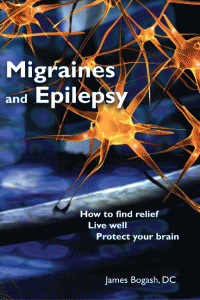
My book, Migraines and Epilepsy, How to Find Relief, Live Well and Protect Your Brian, has a strong focus on the mitochondrial aspect of both migraines and epilepsy.  In a nutshell, when your brain cells cannot produce the energy they need to function optimally, things break down.  Chronic migraine headaches and seizures can result.  While it’s not that simple, this is the basic concept.

When you understand the mitochondria and the role it plays, you can better understand the factors that contribute to migraines and seizures as well as the natural remedies for seizures and migraines that improve brain cell function.

As mentioned by the author, treatments geared towards improving energy needs of the brain cells are “untapped.”  This is probably an understatement, but you begin to see the point.

Overall, by NOT looking at natural remedies for seizures and migraines, researchers have might have missed out on therapies that are more effective and far safer than current medications.  The difference is that this type of an approach to treatment works on healing the brain at it’s most fundamental level–the energy needs of the cell.

Stay tuned…
Filed Under: Migraine, Seizures / Epilepsy Tagged With: epileptic, epileptic seizure, Frontal Lobe Epilepsy, Migraines And Seizures, seizure, Seizure Trigger, Seizure Types, Seizures And Migraines

Chronic Migraine Relief Begins…HERE?

March 26, 2013 by James Bogash

migrane headaches and gluten linked
Migrane headaches and gluten linked

You suffer from headaches and have been searching for some type of chronic migraine relief; so your PCP should send you to a neurologist, right?

It sounds like a great place to start.  After all, your headache is in your head and deals with your nervous system, right?  If you’ve been reading the Rantings for any time now, you understand how flawed this method of thinking is.  Migraines may be felt in the head, but they are really a problem with your entire body.  Something is wrong, and your body is screaming at you to fix it in the loudest way possible.

If this is the case, it certainly makes medicating a headache without finding the root cause shortsighted, if not downright dangerous.  Dangerous because, in those who experience migraines (particularly with aura and in women), there is an increased risk for things like stroke and heart disease.  Merely treating the headache with medications does not lower this increased risk.

So what does all this have to do with this particular study?

There is a well established relationship between food allergies and neurological problems, most notably wheat allergies to gluten.  The list is quite long, but does include seizures, which I have written in a previous blog article that can be read by clicking here.

Given that I’ve written a book on the relationship between migraines and seizures, it should come as no big shocker to you that, if gluten is related to seizures, it just might be related to chronic migraines headaches as well.

Researchers looked at patients with gluten sensitivity and inflammatory bowel disease to see how many of them experienced headaches.  Here’s what they found:

  • Celiac disease led to a 379% higher risk of experiencing headaches.
  • Gluten sensitivity led to a whopping 953% increased risk of migraine headaches (Tweet this).
  • For inflammatory bowel disease, there was an increased risk of 266%.
  • 72% of celiac disease subjects graded their migraine as severe.
  • 30% of IBD graded their migraines as severe.
  • 60% of GS rated his or her headache as severe.

These are some very strong associations.  Strong enough so that any physician treating a patient with migraines should be asking about diet and, more specifically, gluten intake.  If they do not, and the first recommendations are medications, it’s probably time to run the other way.  It would be a strong indication that the physician does not stay current with medical literature.  This is not someone I would want taking care of my brain.

If you suffer from migraines, have you tried a gluten free diet?  If so, did it seem to help?

Filed Under: Migraine Tagged With: Chronic Migraine, Chronic Migraine Headache, Coeliac disease, Gluten, Gluten Sensitivity, Gluten-free Diet, headaches, migraine, migraine headaches, Migraine Relief, migraines, Migraines And Seizures, Migrane Headaches, Patients With Migraine, Prevention Of Migraines, wheat allergy

Migraine Headaches and Seizures Linked

January 31, 2013 by James Bogash

I have stated for years that the causes of chronic migraine headaches and epilepsy are the same. While not generally accepted, it is consistent with current research.

The finding of a genetic link between migraines and epilepsy have been all over the news since this article hit the mainstream media earlier this month.  I have had a standing Google alert for “migraines and epilepsy” for quite some time now.  Nothing was on the radar screen on the Internet until this study hit.

For those of you who know, I have a particularly strong interest in migraines and epilepsy and have spent the past 6-7 years working on my book, “Migraines and Epilepsy: You Are Not Alone.”  During the writing of this book, it has been very common for me to be asked about the combination of the two conditions, because they are not generally thought of in the same sentence.  This includes most specialists dealing with epilepsy and with migraines.

However, the underlying problem with both of these conditions are very, very similar and this particular study lends weight to this concept.

Basically, researchers looked for families that had several epileptics in the family so they could basically single out a family with a strong genetic predisposition to seizures.  Seizures don’t always run strongly in families, so this was the researchers way to kind of “narrow the pool” so to speak.  They then looked at the presence of migraine with aura within these families and found a definite link between the two (Tweet this).

So what does this really mean?  When I think genetics traits, I think of enzymes, because genetic uniquenesses that change the speed of how an enzyme runs is the most common difference or commonality in conditions that run in families (this is called a single nucleotide polymorphism, or SNP for short).  With a genetic link between migraines and epilepsy, I can clearly envision an enzyme that affects how our cells generate energy (the technical term would be SNPs present that affect the mitochondrial energetic pathway).

If several family members have problems generating energy for the brain cells, this can result in different outcomes along the same path.  In one family member it produces a seizure disorder.  In another family member a migraine with aura.

My hope for this study is that we don’t view these as “comorbidites,” meaning that these two conditions just happen to coexist but don’t have much relationship to each other (like high triglyerides and high blood pressure).  Rather, we need to view these two conditions as having the same basic problem, but with a different outcome depending upon the individual.

As an example, (and a bad one, but it’s close to bedtime as I write this) consider stress.  People under extreme levels of stress may experience different outcomes.  Stroke in one, heart attack in another.  And cancer in a third.  All stemming from the same problem, but leading to different outcomes dependent upon uniqueness’s present within the individual’s makeup.

Overall, this post was designed less to educate and more to inform.  If you are a migraine headache sufferer or someone who experiences seizures, pay attention to things that you may learn that help the other condition–it may benefit you as well.

Filed Under: Migraine, Seizures / Epilepsy Tagged With: Chronic Migraine Headache, epilepsy, epileptic seizure, migraine, migraine headaches, migraine with aura, migraines, Migraines And Seizures, Migralepsy, seizure, Seizure Disorders

Primary Sidebar

Patient Quick Guide

Schedule An Appointment
Contact Our Office
Download Patient Forms

Categories

Chiropractic Mesa Arizona

Arthritis Chiropractor Mesa AZ
Graston Technique Mesa AZ
Back Pain Chiropractor Mesa AZ
Back Pain Doctor Mesa AZ
Wrist Pain Chiropractor Mesa AZ
Rotator Cuff Chiropractor Mesa AZ
Shoulder Pain Chiropractor Mesa AZ
Knee Pain chiropractor Mesa AZ
Manipulation Under Anesthesia In Mesa AZ
Headache Chiropractor Mesa AZ
Chiropractic Mesa AZ
Stem Cell Therapy Mesa AZ
Regenerative Medicine Mesa AZ
Massage Therapist Mesa AZ
Shoulder Pain Doctor Mesa AZ
PRP Therapy Mesa AZ
Chiropractic Mesa AZ
Who Is The Top Chiropractor In Mesa AZ?
Knee Injury Doctor Mesa AZ?

Footer

Resources

Site Map
Disclosure
Additional Resources

Best Massage Therapist Mesa AZ
Arthritis Doctor Mesa AZ
Chiropractic Mesa AZ
Back Pain Doctor Mesa AZ
Rotator Cuff Doctor Mesa AZ
Chiropractor Mesa AZ
Massage Therapist Mesa AZ
PRP Therapy Mesa AZ
Knee Pain Doctor Mesa AZ
Stem Cell Therapy Mesa AZ
Headache Doctor Mesa AZ
Shoulder Pain Doctor Mesa AZ

Office

Lifecare Chiropractic
1830 S. Alma School Rd, Ste 135
Mesa, AZ 85210
(480)-839-2273
Also Serving Tempe, AZ

Get Directions

  • Home
  • About
  • Common Conditions
  • Additional Services
  • Testimonials
  • Blog
  • E-Books
  • Contact

Copyright © 2026 · LifeCare Chiropractic · All Rights Reserved.