WHAT DO YOU MEAN YOU’VE NEVER BEEN TO A CHIROPRACTOR?? I attending a marketing event this week at a company where the employees are at their computers most of the day. I was shocked at the number of employees who had never been to a chiropractor before. Many of these patients had been experiencing pain for many, many years and no one had referred them to a chiropractor. Keep this in mind…the research is solidly in favor of manipulation for many conditions and our safety profile is unmatched. “Informed consent” is the REQUIRED responsibility of every provider. They have to explain to a patient about their condition, the risks of treatment and the risks of non-treatment. They also have to outline viable alternatives. This means, that for conditions like neck pain, low back pain and headache, it is MALPRACTICE if a physician does not mention chiropractic care as an alternative treatment. Going back to all these employees that mentioned they had never seen a chiropractor before…it is flat out malpractice for these patients to have been treated by a physician and chiropractic not given as a viable, safe alternative. Read More…
Natural Pain Relief
Knee Pain Chiropractor Mesa AZ
Don’t Wait, Pain Gains
SHOULD I WAIT TO SEE IF MY PAIN GETS BETTER FIRST? It is very common for someone who has injured themselves, be it their back, shoulder, neck, knee or spleen (ok…maybe not really the spleen), to wait and see if the pain goes away. Sometimes is does, but sometimes this is the beginning of what will ultimately develop into chronic pain. I can tell you that, from my chiropractic perspective, that the sooner someone comes in to see me after pain begins, the sooner they recover. If someone comes in within a week or so, many times we can knock out the problems in just one visit (for established patients that understand the way we treat soft tissues). This particular study finds that, at least for low back pain, not getting relief within the first 3 months and being afraid to move too much for fear of worsening the injury were risk factors for chronicity. I can tell you that these are factors we address heavily with every patient. Many patients are still told to restrict activities for a period of time until they get better. This is usually very bad advice. Read More…
Chronic Neck Pain After a Car Crash
SHOULD I SEE A CHIROPRACTOR IN MESA AFTER MY CAR ACCIDENT?
Of course, my biased answer is going to be a solid yes. Most patients that come through my office as the result of a motor vehicle accident will be discharged from care when I have done everything possible to ensure that they will not be in another chiropractor’s office in 10 yrs complaining about neck pain “ever since that accident 10 yrs ago.” The bottom line is that the number of patients still experiencing symptoms years later is far too high. My advice to anyone who has been in an accident is to seek the care of a chiropractor who is going to address the soft tissues as well as the joints in your treatment plan.
Afib Risk and Ibuprofen
ANOTHER BAD EFFECTS OF ANTI-INFLAMMATORIES?? Is it just me, or is the list of side effects of NSAIDs getting longer and longer? And we really all have Merck and Vioxx to thank for this direction of the research after well over 100,000 cardiovascular events were estimated to have occurred as a result of the new blockbuster drug when it was released.
As way of comparison, does chiropractic care increase the risk of atrial fib, chondrocyte death, heart attack, kidney dysfunction, liver dysfunction or bleeding ulcers? Funny that adjusting ONLY (which would not include all of the soft tissue work, stretching, lifestyle changes and use of Graston that we do in the office) fares just as well for most conditions as this class of drugs but a handful of misguided critics still feel that chiropractic care is “not worth the risk”…
Worker’s Comp and Chiropractic
Will Workers Compensation Cover a Chiropractor?
Experiencing an injury while at work can comes with its’ fair share of hardships. There are a number of injuries a person may suffer from as a result of an accident at work. Some people may choose to obtain the services of a chiropractor as a natural alternative to pain management. There are several benefits to chiropractic care, especially for those suffering a multitude of ailments and problems that may be causing them pain. Although in most cases an employee may be eligible for chiropractic care under workers’ compensation, it’s always a good idea to follow up with your employer beforehand.
Chiropractic Care
A chiropractor can offer a natural alternative to pain medications and/or surgery. When a person is in chronic pain, they will do just about anything to experience some sense of relief. Seeking chiropractic care can be a solution to common pain people may suffer. A chiropractor believes that the nervous system is tied to the spine. Meaning, a number of problems can be corrected or mitigated while being treated by a chiropractor. Chiropractors can help their patients’ manage issues that include:
- Headaches
- Joint Pain
- Headaches
- Ear Problems
- Back Pain
- Neck Pain
For many, visiting a chiropractor is an attractive option for those suffering from chronic pain. It is believed that by aligning the spine, the body can better function with reduced pain, and symptoms can be kept in check.
Reasons to See a Chiropractor
There are a number of reasons people choose to see a chiropractor. For some, a chiropractor is just one component to recovering following an injury from workers’ compensation. A chiropractor can team with your medical team in order to provide you with the most consistent and best care possible. Reasons to seek the care of a chiropractor can stem far beyond workers’ compensation injuries, including:
- Gastrointestinal Problems
- Poor Sleep Habits
- Illness Prevention
- To Help Manage Asthma Symptoms
- Chronic Pain Management
- Naturally treat ailments as an alternative to medication
If you are suffering from pain or limited mobility from an accident, it may be in your best interest to consult with a chiropractor. They may be able to not only help manage your pain, but aid in your recovery so that you are able to return to work as quickly as possible.
Workers’ Compensation and Continued Care
There can be a number of unknowns when faced with an at work injury. You will likely be worried about whether or not you will be able to return to the same duties as you did prior to your injury. Depending on your injury, a chiropractor may be able to successfully treat your ailments so that you are able to return to your job. If you require further chiropractic treatment, your chiropractor may request further approval or authorization from your employer in order to do so. Turn to your workers comp attorney, like the Worker’s Comp Attorneys Milwaukee, WI trusts, with any further questions.
If you have been injured while at work, it is vital that you seek the care of a medical professional. A chiropractor may be an attractive option to mitigate pain and other symptoms you may be suffering from as the result of your accident.
Thanks to our friends and contributors from Hickey and Turim SC, for their insight into workers compensation law.
Reflections on 20 Years in a Chiropractic Practice
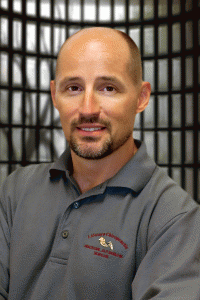
In March of 1998 I left the frigid tundra of the Chicagoland area to start a practice on my own in sunny Arizona. Thus started the Chiropractic chapter in my life.
And I’ve learned a lot in this time frame. And have probably forgotten just as much as I learned.
Had you asked me with I was 10 or 16 or even 25 what I would be when I would grow up, a chiropractic physician would definitely not have been on the list.
It pretty much wasn’t until I was in chiropractic school that I would’ve answered that I wanted to be a chiropractor when I grew up. But even in chiropractic school I had a different idea of how my practice would look—I was sure I would have a practice that was heavily involved in treating athletes because of my martial arts background.
However, the thing I was most blindsided by was the initial process of building a practice from scratch in an area of the country that was brand new to me. The idyllic side of me gave myself 6 months to a year to build a solid practice with a comfortable income.
Wow.
Talk about being off.
Those initial years I spent becoming heavily involved in the community through the local Chamber of Commerce, the Red Cross and Kiwanis. I had lots of time but little money—volunteering fit in my budget.
I’d have to say it was 5 years before I really had an idea that the practice was stable enough to survive. And now, 20 years later, the practice does have an inertia to it from building it the right way—treating patients right (more on this later) and being a reliable go-to in the community for all things health.
But make no mistake; it still takes effort to keep the doors open.
The Foundations
We all have our mentors that still shape our daily lives 20 years later. Some are still around, some have passed. Some we’ve followed closely, some from afar.
Dr. Jedlicka – Foundations of a Chiropractor
Dr. James Jedlicka was a technique instructor in Flexion-Distraction (a technique that shines for treating disc problems and stenosis) at National. I was one of two students chosen to be his teaching assistants for almost half of my schooling. That meant there were typically 4-8 students at any given time. This meant a lot of 1-on-1 time with an instructor who had been practicing for many decades.
Helping out in class as well as late afternoon happy hours gave us teaching assistants a different view of chiropractic than the norm. One that had more to do with patient outcomes and less to do with making money and politics.
While Dr. Jedlicka is no longer with us, his influence on my practice is there every day.
Dr. Kaminsky – Critical Thinking
I remember his booming Omaha-bred voice in class, frequently disrupting the auditorium next door. What I remember more is how he would post research articles on the overhead projector (long before PowerPoint) and rip into the details.
He was the first one to show me how powerful the medical research was and how often this life-changing information is buried, misinterpreted or just completely ignored.
Acute otitis media with effusion, or OME. 20+ years ago we already knew that antibiotics were a bad idea for this condition and there was research supporting this position, despite the fact that doctors were continually pumping children full of antibiotics for it. Dr. Kaminsky pointed out the first of many mis-guided approaches across medicine in his classes.
Dr. Richardson, Dr Varnas and Dr. Bland—Passion for Nutrition / Physiology
Cellular physiology. Just the name strikes fear in most normal students.
I was not one of them.
Human physiology is incredibly complex and very poorly understood and most just aren’t interested in learning the details. But NOTHING is more important to helping sick patients get better than understanding the way the human body works.
My passion for human physiology started with Dr. Daniel Richardson early in chiropractic school. While many (OK..most) of my fellow students couldn’t bear the class, I really loved the class and all it had to offer.
This paved the way for my clinical nutrition class taught by Dr. Paul Varnas. You really can’t understand nutrition unless you understand physiology. He was the first to really show how powerful nutrition could be when combined with an understanding of how the body works.
Dr. Varnas was also the first to introduce me and several classmates to Dr. Jeff Bland. I attended my first “Bland seminar” in 8th trimester of school and was astounded by what I heard Dr. Bland say.
And, by the next day, pretty much forgot it all.
But it was the beginning of some 15 years of going to Dr. Bland seminars and getting new information about human health and disease years before it would hit mainstream. As the years went by, I learned less and less new information, but refined what I had learned in my own studies in the past year.
This blending of nutrition, physiology and targeted supplementation has always been a massive part of the way I practice. Because of this, I have been able to help patients over the years with conditions that they couldn’t find answers for elsewhere.
Continued Learning
All educational experiences are designed to give you a background for lifelong learning. This includes post-graduate studies like medical, osteopathic, naturopathic and chiropractic. What I learned in school was truly dwarfed by what I’ve learned since then.
For almost my entire practice life, I been a voracious reader of medical literature. It started in the old-fashioned paper journals at ASU’s Noble library—going there about monthly to copy new articles that were references from the articles I copied last visit.
I had quite the stack of copied articles.
And another dilemma—how to file the articles. Should an article on diabetes contribution to heart disease be in my heart disease binder or my diabetes binder?? Should I just make two copies and put on in each binder?
Not very green.
And then came along this thing called the Internet.
Sure—it had already been around for a few years, but the reason I launched my website late in 1999 it was basically a place to store all the articles I found. This newsletter was original just termed research updates.
As more and more medical journals came online, it became obvious that someone with a disturbed passion for reading medical research could forget to eat.
Once I had everything in place, I was typically (and still am) reading around 120 medical journals a month, looking for things related to natural medicine, disease prevention, disease management and the way the human body works.
It frustrates me how much information is out there, and yet mainstream medicine blatantly remains oblivious or flat out ignores so much that could end or decrease human suffering. It seems like most physicians stop learning when they leave school.
I don’t expect most physician to be as maniacal on staying current as I am, but it’s disgusting to think that an oncologist doesn’t stay current on lifestyle choices that increase survival or a cardiologist who still thinks lowering dietary cholesterol is the key to preventing heart disease.
Quite frankly, it’s inexcusable.
Changing Lives
One of the things that makes the day to day struggles of running a business are the lives that are changed from interactions with the practice. Patients whose lives are truly changed because they found our clinic at the right time in their lives—a time when they were ready to make changes.
I’ve got hundreds of stories. They range from purely musculoskeletal, like 20 years of headaches gone in 5 visits, to complete resolution of fibromyalgia symptoms from adding a simple supplement.
These are the experiences that every provider longs for. Most of us entered the healing professions to help people. Being in a chiropractic office with a background in functional medicine allows me to help patients in ways that no other provider can.
It is because of this that I will probably never officially retire from active practice. I may slow down; I may practice on the beach somewhere, but I will never retire from helping patients. It’s a fundamental part of who I am as a person.
Practicing What I Preach
Another important factor in these 20 years of practice is making sure that I practice what I preach.
When was the last time that you were told by an overweight physician that you needed to lose weight? Or knew that your PCP was a smoker?
I know that a part of making me a credible lifestyle coach is to life the lifestyle that I promote. I’m not saying that I don’t sneak a wee bit of chocolate birthday cake or the occasional Smashburger, but in general my family eats a low calorie, high phytonutrient diet while focusing on eliminating / reducing our exposure to toxic chemicals in the environment.
These means no wonderfully smelly dryer sheets, no air freshener, no food stored in plastics. It means chasing the occasional cricket or cockroach around the house because we don’t use a pest control service.
It means that I try to stay as active as possible. I still train in the martial arts (jiu-jitsu for the past 6 years or so) and have every intention of continuing to train for as long as I can. My workout routine always includes some type of short-burst aerobic as well as simple strength training like pull-ups, chin-ups, push-ups, ab-wheel and handstand push-ups.
If I get injured or get a headache, knee pain, low back pain or shoulder problems, I get soft tissue work and adjustments to resolve the condition.
I haven’t taken any prescription or even over-the-counter medication in probably 25 years, despite numerous martial-arts injuries and other conditions that the commercials tell you should need medications. Haven’t even vaguely considered an antibiotic for almost 30 years.
On the flipside from avoiding drugs, I take a high quality multivitamin (Pure Encapsulations Ultra Nutrient), 6,000 IU of vitamin D (Biotics brand), 6,000 IU vitamin A (you guessed it..Biotics) and 2,000 mg omega-3 fatty acids (also Biotics brand).
Religiously.
If I didn’t practice what I preach, it would make me a hypocrite. And patients would see why through the deception and not listen to a word of advice from me.
Chiropractic as the Red-Headed Stepchild of Healthcare
I’ll end with the one thing that continually threatens to drag me down from my happy place.
Insurance.
When I first started out everything was actually pretty good. I became a provider for Cigna almost right out of the gate and their reimbursement was fair.
It took years to get in network with Blue Cross but once I was it was also a good thing.
United Healthcare was fair, although paid less than the other two.
There were some bumps in the road, but basically everything was good. I felt that I was reimbursed fairly for the services I provided. If I spent more time with a new patient because they had a complicated history I would get reimbursed for my extra time.
Our practice model survived the downturn in the economy around 2010 and even thrived.
Enter 2013 in Arizona and the worst thing that could happen to the practice of chiropractic. A middleman company took over the contracts for Cigna and Blue Cross. They already held the contracts for Aetna from a few years prior. (In 2017 they also took over the contracts for Banner Health—a large hospital network in the Southwest).
One single company basically controlled all of the healthcare contracts (with the exception of United Healthcare). And these were “take it or leave it” contracts.
This might not have been bad. Some middleman companies over the years have ben reasonable to work with and paid well.
Except this company, American Specialty Health, had a fee schedule that was around 50% lower than what we had been paid by the representative insurance companies.
Fifty percent.
Imagine that. You’ve spent years building a practice, doing the right things. The practice grows and your expenses increase as expected. Rent goes up, utilities go up, employee salaries go up, the cost of goods goes up.
Then the rug gets pulled out from underneath you with around 3 months’ notice. A time frame that makes it impossible to cut your expenses. This wasn’t a gradual whittling away of what we were getting paid. It was a slaughter.
How would the average employee fare with a 50% hit to his or her salary? The average company whose widget price just got slashed 50%?
If that wasn’t bad enough, the company is a paperwork nightmare. Authorizations, claims problems, never-received faxes, improper notification of claims.
Many offices were crushed when this company took over. Fortunately, over the years I had been increasing our from cash based services (massage, supplements, etc…) so we survived, but it was still a painful process.
Some of you might suggest that I shouldn’t have made a deal with the devil and signed the contract.
I didn’t. And yet American Specialty Health still manages the out of network benefits for these insurance companies. In other words, you can’t avoid them. In other words, after 5 visits I had to get my treatment approved by this company.
And as much as I pride myself on keeping good notes, they are never good enough for the reviewers as American Specialty Health. As a rough estimate, I would say I got 1 visit approved for every 20 I asked for.
Most of my interactions were with a single reviewer and her and I just didn’t see eye to eye on documentation. She wanted a clear-cut course of treatment, where the patient comes in for 3 times the 1st two weeks, twice a week for the next 4 weeks, etc…
Seeing the patient as needed is a big problem with this company. They would rather me see a patient 15 visits in an orderly fashion instead of 10 visits over the course of the year where the patient comes in when they feel they need it.
Over the years, we’ve just let patients know that their insurance company (Blue Cross and Cigna—Aetna was luckily a different story in our office) just wasn’t going to pay anything for their care in our office.
Sad. Especially considering that patients pay a LOT of money for their insurance and really would like it to cover something. Especially something as valuable and cost-effective as chiropractic care (chiropractic care is one of the most effective AND cost-effective treatments available, saving billions of dollars in imaging, drugs and surgeries).
But at least we still had United Healthcare. They didn’t pay the greatest for our care, but at least we were reimbursed for some of the time we spent with patients.
Then came June of 2016.
UHC moved to what is known as a per diem. They were going to pay a maximum amount per visit and this dollar amount was about 20% lower than what we had been getting reimbursed.
Here’s the real rub. American Specialty Health and United Healthcare will only pay a certain dollar amount per visit.
It doesn’t matter whether I spend three hours with a patient and perform the most amazing intake and treatment ever done in the history of medicine—I get paid the same as if I spent 15 minutes with the patient.
This is probably what bothers me the most. I love spending time with new patients going over their health history, educating them on things that they can do to improve health and manage disease.
But this takes time. Time that I know longer get paid for.
So, early in 2013 and June of 2016 these fee schedules were implemented.
If history is any indication, the initial reimbursement dollar amount will NEVER change.
Yep. The contract offered in 2013 was for a certain dollar amount. In the past 5 years American Specialty Health has not given any indication that they are ever going to increase what they pay.
What does this mean?
Expenses always go up with time, but the payments made don’t.
It means that, for the average chiropractor, the ONLY option, just to stay even, is to constantly increase the number of patients they treat over time.
And yet the companies that control all the chiropractic care for patients could care less. They are out to squeeze all the profits off the backs of chiropractors for as long as they can get away with it.
Summarizing 20 Years
I couldn’t end this article with the last section on insurance, but I also couldn’t leave it out. It the ONE thing in practice that leaves a shadow on the entire experience.
I do personally believe that, within a few years, insurance as we know it will go away. Premiums continue to go up and up for less and less coverage and higher deductibles.
Quite frankly, I will relish that day because I know that our office offers some of the most effective and efficient forms of medicine.
As I type this, I just got a voicemail from a patient that I saw once 2 days ago. His back pain is gone, he is switching to short-burst aerobic activity and he’s going to do his best to avoid dairy.
You see-he’s just a little older than me and has been a Type 1 diabetic and is not making the best lifestyle choices. I spent quite a bit of time with him on his first visit discussing simple changes to improve his health.
And the back pain he thought was the only thing he was coming in for.
Even if this patient never comes back in but continues with the simple changes we talked about, the rest of his life will be better.
THAT is value.
And when insurance goes away this type of care is what will survive.
It’s also the type of care that gives me the most personal satisfaction and that I will never stop providing, regardless of payment methodologies.
Twenty years in and I still would not change my profession or the way that I run my practice. While the information I learn now comes in trickles, I will never stop learning.
I will never stop learning how to help my patients make better choices.
I will never stop learning ways to resolve or at least relieve the pain that brings patients’ through the door of the clinic.
I may, however, move to a beach in Mexico somewhere….
Until year forty…
Find a Back Pain Chiropractor Mesa AZ
Chronic LBP:
SHOULD I WAIT TO SEE IF MY PAIN GETS BETTER FIRST? It is very common for someone who has injured themselves, be it their back, shoulder, neck, knee or spleen (ok…maybe not really the spleen), to wait and see if the pain goes away. Sometimes is does, but sometimes this is the beginning of what will ultimately develop into chronic pain. I can tell you that, from my chiropractic perspective, that the sooner someone comes in to see me after pain begins, the sooner they recover. If someone comes in within a week or so, many times we can knock out the problems in just one visit (for established patients that understand the way we treat soft tissues). This particular study finds that, at least for low back pain, not getting relief within the first 3 months and being afraid to move too much for fear of worsening the injury were risk factors for chronicity. I can tell you that these are factors we address heavily with every patient. Many patients are still told to restrict activities for a period of time until they get better. This is usually very bad advice. Read More…
Mesa AZ Chiropractor provides insight on a new drug
DOES THIS SUPPLEMENT WORK AS WELL AS A $1500/MONTH DRUG?
This is not the first time that we have seen that essential fatty acids are quite potent at suppressing inflammation. In this particular study (an animal study) we see that alpha linolenic acid (the same fats found in flaxseed, walnuts, chia, salba…) helps to suppress TNF-alpha expression, which is the same target of the very expensive class of drugs that block the action of TNF-alpha (Remicade, Humira, Enbrel). This is not to suggest that one replaces the other, but it again shows that essential fatty acids being stripped from our heavily processed diets may have a strong tendency to shift our bodies towards inflammation.